High-Gravity Brewing: What Changes at 33 Plato
Thirty-three degrees Plato is roughly a wort with a third of its weight in dissolved extract, strong enough that most breweries never push a single vessel that far. HGMC publishes beer up to 33 Plato as a design ceiling, and the interesting part of that figure is not the number itself but what has to change to reach it: mash load, lautering, cooling, yeast handling and the headspace above the kettle.

Key takeaways
- The manufacturer's published design ceiling is beer up to 33 Plato, which is a strong wort by any measure.
- Higher gravity means more grain in the same mash tun, so mash thickness, lautering time and vessel load all change together.
- Published equipment advantages aimed at this work include piping designed to avoid wort aeration, jackets on both the body and the cone, and headspace calculated separately.
- The published 10 BBL example range of US$75,000 to US$200,000, plotted below, is a brewery figure rather than a high-gravity upgrade price.
What a Plato figure actually measures
Degrees Plato express the concentration of dissolved extract in wort as a percentage by weight, so a 13 Plato wort is about 13 per cent extract and a 33 Plato wort is about a third extract. Two practical consequences follow. First, gravity scales almost linearly with the amount of malt you put through the mill for a given volume of water, so a batch that is two and a half times stronger needs roughly two and a half times the grain. Second, viscosity rises with concentration, which is why a strong wort drains more slowly through the grain bed and why lautering becomes the slowest part of the day.
Most breweries use high gravity deliberately rather than as an end in itself: brew a concentrated wort, then dilute it with treated water to the strength that goes in the package. The technique is usually called high gravity brewing, and its appeal is capacity. One kettle, one lauter and one fermentation tank can supply two or more times their own volume of saleable beer, which is why the published ceiling of 33 Plato is a capacity statement as much as a technical one.
What changes in the brewhouse
Mash thickness is the first change. The same mash tun holds more grain and roughly the same water, and the mixture becomes stiff enough that agitation and temperature control have to work harder to keep conversion even. A mash that is not mixed properly leaves dry pockets, and dry pockets do not convert.
Lautering is the second change, and it is the one that usually decides whether a high-gravity brew fits a shift. The grain bed is deeper and the wort is more viscous, so run-off slows. Brewers compensate with a coarser crush, a longer sparge, or a separate lauter vessel that can be emptied while the kettle works, which is one reason a 3 or 4-vessel brewhouse is often specified by breweries that intend to brew strong.
Boiling follows the same pattern: a concentrated wort has less free water to evaporate, and hop utilisation falls as gravity rises, so recipes need more hops for the same bitterness. HGMC publishes advantages that speak directly to these steps, including energy saving with higher brewing efficiency and lower material consumption, fully automatic mash, wort and water flow with automatic temperature control, and a specially designed steam system.
What changes on the cold side
High gravity is harder on yeast than on steel. A concentrated wort is a high-sugar environment at the start of fermentation and a high-alcohol environment at the end, which stresses the culture from both directions, and the published material addresses the oxygen side of the problem by designing piping to avoid wort aeration. Fermentation temperature control becomes more critical rather than less, because a strong ferment generates more heat per litre, and the published jacket design, on both the body and the cone, exists to pull that heat out evenly.
Headspace is the last cold-side item worth checking. HGMC publishes a bigger headspace in its vessel design, with the cover headspace volume calculated separately, and a strong ferment with a vigorous krausen is exactly the case that design is meant for. Set against that, the fermentation tanks and bright tanks supplied alongside the brewhouse are the items that decide how a strong batch is stored, because a 33 Plato wort that is diluted before packaging takes more tank volume than its own batch size suggests.
| Wort strength | What it looks like in the tun | What it asks of the equipment |
|---|---|---|
| 10 to 12 Plato | Thin mash, fast run-off | Standard vessel sizing and standard cooling |
| 16 to 20 Plato | Thicker mash, slower sparge | More mash agitation, longer lautering, more yeast |
| 24 to 28 Plato | Stiff mash, heavy grain load | A dedicated lauter step and a larger cooling duty |
| 30 to 33 Plato, the published ceiling | Very concentrated, viscous wort | Headspace calculated separately, jackets on body and cone, aeration avoided in the piping |
Worked example
Worked example, with assumptions written out. Start with 1,000 L of wort at 33 Plato and dilute it to 13 Plato, a common packaging strength. Assuming extract is conserved, that no water is lost and that 1 L of wort is close to 1 kg, the arithmetic is 1,000 L multiplied by 33, divided by 13, which gives 2,538 L of finished wort. In the same arithmetic the extract charge is about 330 kg, and 330 kg divided by 0.13 also gives about 2,538 L. Dilution volume, losses in the cellar and the exact strength of the treated water are all planning assumptions of mine, not published figures.
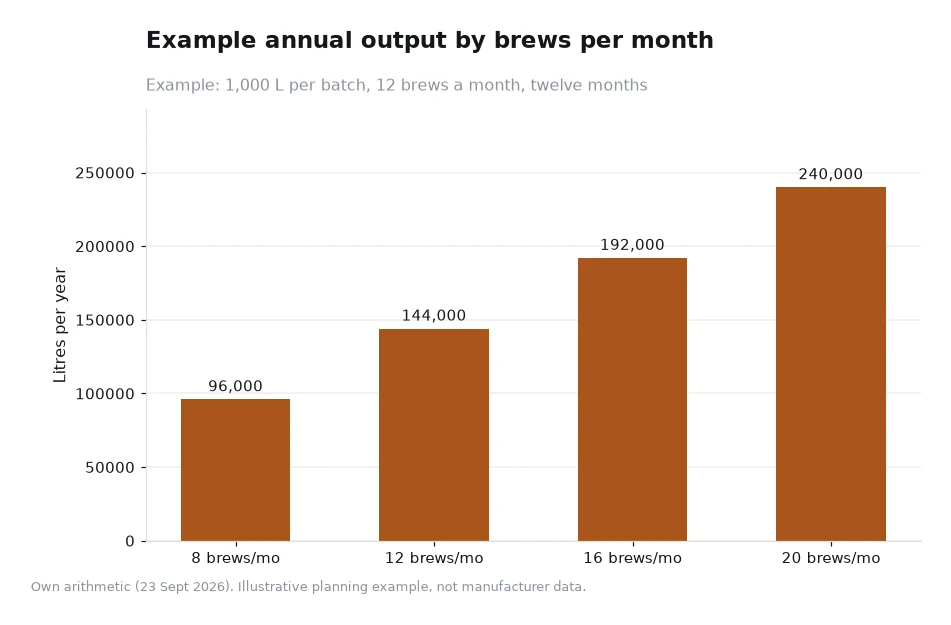
Now put that alongside the chart below, which plots example annual output at a 1,000 L batch: 96,000 L at 8 brews a month, 144,000 L at 12, 192,000 L at 16 and 240,000 L at 20 brews. Take the middle case, 144,000 L of 33 Plato wort a year. If every litre were diluted 33 to 13, the packaged volume would be 144,000 multiplied by 2.538, which is about 365,538 L a year. The chart plots batch volume as brewed; the diluted figure is my own labelled extension of it.
The two numbers together explain why a brewery chasing capacity looks at gravity before it looks at a bigger kettle. The same vessels and the same brew count produce roughly two and a half times the packaged volume, and the price frame published for a complete 10 BBL system, US$75,000 to US$200,000 before valves, pipes, steam boiler and site-specific extras, is a brewery figure rather than a high-gravity upgrade figure.
Frequently asked questions
What is the highest gravity this equipment is designed for?
The manufacturer publishes beer up to 33 Plato as a design ceiling, supported by piping designed to avoid wort aeration, jackets on both the body and the cone, and headspace with the cover volume calculated separately.
Why dilute a strong wort instead of brewing at packaging strength?
Diluting a concentrated wort produces more saleable beer from the same vessels and the same number of brews, which is the capacity argument for high gravity brewing, though it moves the work into water treatment and blending control.
Testing a strong recipe before you commit
Work the arithmetic backwards from the packaged volume you need, then ask how much extract per litre the brewhouse has to carry. The published Brewing Equipment range covers the beer side of the plant, and the brewery systems pages show how the brewhouse, fermentation and bright tanks fit together for a strong recipe. Layout and piping questions are handled in the free 2D, 2.5D and 3D design service, and the brewhouse equipment section is where vessel count and heating method are settled. Bring the strongest recipe you intend to brew to that conversation, not the average one.
The published material used here, read from the manufacturer's own website on 23 Sept 2026, includes the 33 Plato design ceiling, the pipeline design that avoids wort aeration, the jackets on body and cone, the separately calculated cover headspace volume, the steam system and automatic mash, wort and water flow, and the 10 BBL price range of US$75,000 to US$200,000 before valves, pipes, steam boiler and site-specific extras.[1] The Plato bands and the dilution arithmetic are labelled planning work by this page.