Evaluating an OEM Perfume Manufacturer in China: A Scorecard
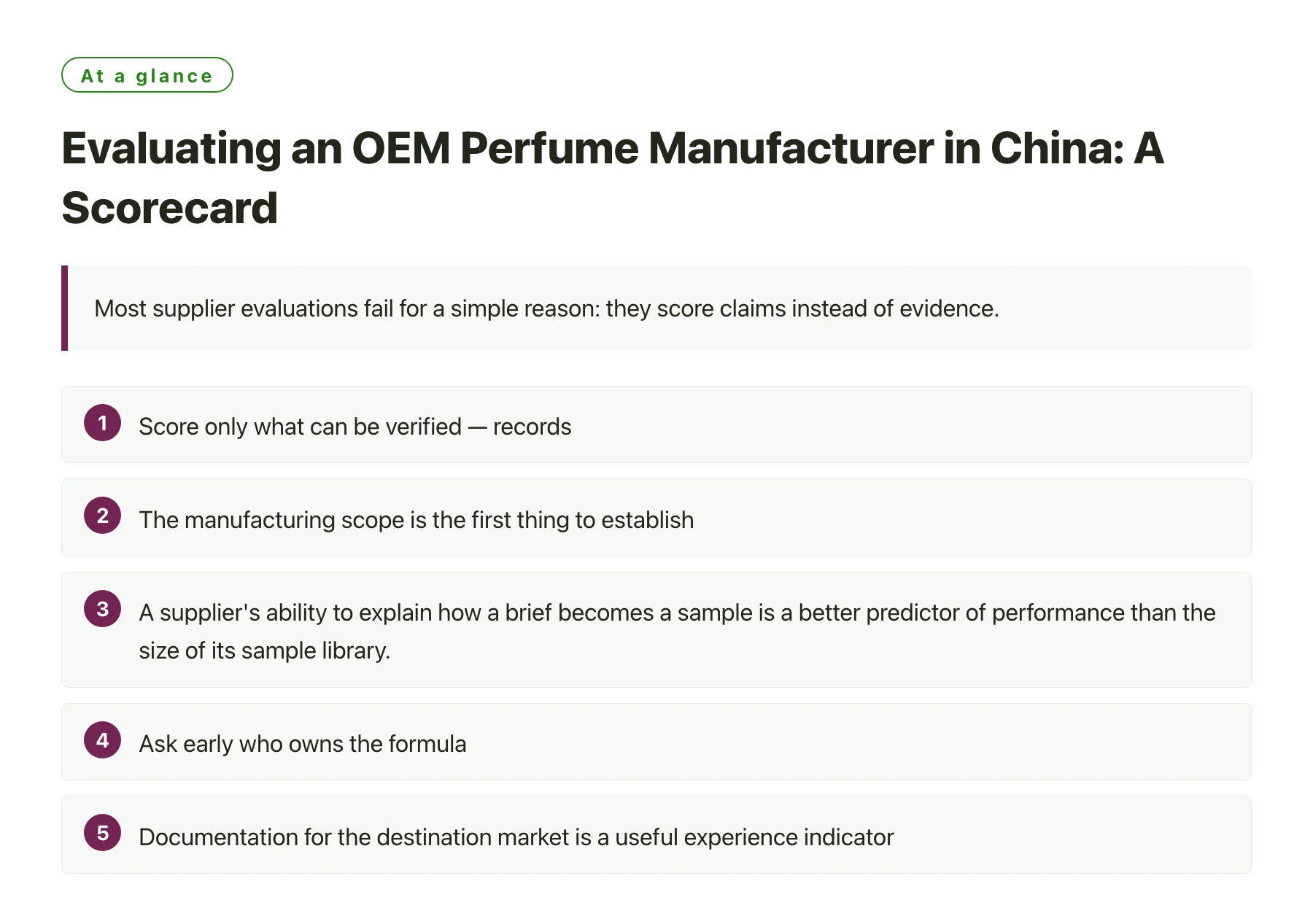
Most supplier evaluations fail for a simple reason: they score claims instead of evidence. Every candidate will say it has an experienced research team, reliable quality and competitive pricing. A scorecard only becomes useful when each line describes something the buyer can verify, and when the verification method is written next to the criterion before the first call.
Key takeaways
- Score only what can be verified — records, ranges, named suppliers and written scope — and leave adjectives out of the evaluation entirely.
- The manufacturing scope is the first thing to establish, because in-house and subcontracted steps carry different lead times and different points of failure.
- A supplier's ability to explain how a brief becomes a sample is a better predictor of performance than the size of its sample library.
- Ask early who owns the formula, the mould and the design files, and get the answer in writing before signing anything.
- Documentation for the destination market is a useful experience indicator, but it is not proof that your specific product is compliant.
Sourcing fragrance production in China is not difficult to do badly. The market is deep, the range of suppliers is wide, and the first few responses to an enquiry often look similar because they are written to look similar.
This is a scorecard for the stage before samples: the point at which a buyer has three or four candidates and needs to reduce them to two. It is written from a sourcing perspective, which means it is biased toward things that can be checked in a week rather than things that require a relationship to discover.
The scoring is deliberately crude — each criterion gets a strong, weak or unclear answer — because the value is in the questions, not in a decimal score.
Score evidence, not adjectives
The first discipline is to remove every criterion that can be answered with a marketing sentence. 'We have a professional R&D team' is not a criterion. 'Describe the last brief that required a formula adjustment, how long the adjustment took and who approved it' is.
Buyers who do this consistently find that the shortlist reorders itself quickly. Suppliers with real operating depth answer operational questions with specifics, because they have the specifics. Suppliers without it pivot back to the certificate list. When four candidates all describe themselves as an OEM perfume manufacturer in China in almost identical language, that sameness is itself the signal to stop reading descriptions and start asking for records.
Establish the manufacturing scope first
Ask for a written list of which steps are performed in house: compounding, filling, decoration, assembly, testing, packing. Then ask who performs the steps that are not on the list. Neither answer is disqualifying, but the two together determine the lead time, the number of handoffs and where a failure would occur.
A factory that buys in decoration and assembly is not a worse partner than one that does everything; it is a different one, and it needs to be managed with that in mind. What is disqualifying is a supplier who cannot say which is which.
Test the sampling loop
The sampling loop is the best available proxy for how the relationship will run. Ask how many rounds are normally included in a development project, what happens if a round fails, and how the approved reference is recorded. A supplier who answers precisely is describing a process; one who answers vaguely is describing an intention.
A related question is who evaluates the scent. If the answer is a named evaluator with a defined role, that is a good sign. If the answer is 'our team will review it', ask to speak to the person who will actually make the comparison.
Ask who owns what at the end
Ownership questions feel premature during evaluation and become urgent later. Who holds the formula if the brand paid for its development? Who holds the bottle mould if the brand paid for the tooling? Are design files delivered on request? Names, logos and industrial designs can be registered nationally or through the international systems administered by WIPO, and a brand that intends to protect its packaging should know who is holding the underlying assets [1].
A supplier's answer here is a good indicator of how it behaves in general. Clear answers cost nothing to give, and a reluctance to give one is informative.
The scorecard
| What to assess | What a strong answer looks like | How to verify it |
|---|---|---|
| Manufacturing scope | A written list of in-house steps with named partners for the rest | Ask for the list, then ask who does the remainder |
| Quality system | Documented process control with batch numbering and deviations | Request one batch record, redacted if necessary |
| Development capability | An application lab able to adjust a formula on request | Ask how a brief becomes a sample, and how long that takes |
| Sampling discipline | Sealed, dated references held by both parties | Ask to see a retained standard from a previous project |
| Component sourcing | Named glass and closure suppliers with stock ranges | Ask which parts are stock and which require tooling |
| Test and inspection | Reports that match recognised cosmetics testing scope | Compare a sample report against a laboratory's published scope [2] |
| Export documentation | A prepared pack for the markets the supplier serves most | Ask for a redacted version covering your destination market |
| Ownership terms | A clear position on formula, mould and design rights | Ask who holds the tooling and what happens if the relationship ends |
| Communication | One named contact who answers technical questions directly | Send one technical question before the call and time the reply |
If two candidates score similarly, the tie-breaker is the communication row. A supplier with a slightly weaker scope but a direct technical contact is usually easier to run a project with than the reverse.
The questions that change the ranking
Two questions tend to separate candidates more than the rest. The first is what happens when a batch does not match the approved sample. A supplier with a working quality system will describe an investigation, a retained standard comparison and a disposition. A supplier without one will describe goodwill.
The second is what the quotation excludes. Tooling, artwork, testing, documentation, freight and duty are the lines that reappear later, and a candidate who lists them without being pushed is usually a candidate who has been through this conversation many times.
It is also worth asking how the supplier handles a formula change after approval, because that is where cost and schedule quietly move. A change that touches the fragrance declaration list can affect the label, and a change made after artwork approval can affect the print run.
A related question is whether the supplier supports both OEM and ODM models. A business that does only one will usually describe its scope crisply; one that does both has had to explain the boundary to customers. A candidate that presents itself as a manufacturer that supports OEM and ODM is describing that boundary in public, and where a project may start from an existing base and later move to a developed one, the answer decides whether the change is a new project or a continuation.
Use the plan you already have
If the project has a defined pack and a target market, send the same written brief to every candidate and compare the responses line by line rather than in sequence. The same two-page brief produces answers that are directly comparable, which is more useful than four conversations that each went in a different direction.
Score the shortlist on a single page and keep it. When a project runs into difficulty six months later, the page shows whether the warning was already visible in the evaluation — and whether the criterion that failed was one you scored or one you skipped.
Where the shortlist usually narrows
In practice, most shortlists reduce to two candidates on three criteria: scope, documentation and ownership. The rest is usually comparable. That is a useful thing to know before the evaluation begins, because it means the buyer can spend the first call on the three criteria that decide the outcome instead of working through a long questionnaire in order.
A manufacturer that supports both OEM and ODM work will often be able to describe its scope more precisely than one that does only one, simply because it has had to explain the boundary between the two to customers. That is not a reason to prefer it in every case, but the question is worth putting to every candidate.
The evaluation also gets easier if the supplier publishes its own position. A company that describes the company behind the factory — its history, its certifications and its service scope — gives a buyer a document to test its answers against. That does not replace verification, but it makes the first call more productive.
For the stage that follows, the checks worth putting into a written agreement are set out in Xuelei's guide; reading it before the final round often changes what a buyer asks for in the evaluation itself.
Sources
- WIPO — World Intellectual Property Organization —— The UN agency for intellectual property; resources on industrial design and patent protection relevant to product and packaging design.
- SGS: Cosmetics, Personal Care & Household Testing —— Testing, inspection and certification services for cosmetics and personal care, including microbiological, stability and safety testing aligned with cosmetics GMP.
Frequently asked questions
How many suppliers should be evaluated?
Three or four is usually enough to see how the market answers the same brief, and few enough to keep the comparison fair. Beyond that, the marginal information from each additional candidate tends to be small.
Is a bigger factory always better?
No. Size affects scheduling flexibility and the minimum quantities a plant will accept, but it says nothing about how well a project is managed. A mid-sized factory with a named technical contact can be easier to work with than a large one where the enquiry passes through several hands.
What should I send in the first brief?
The pack, the fill volume, the target market, the number of variants, the target quantity and the retail price expectation. That is enough for a supplier to answer the scope question precisely and to flag anything the brief has left undefined.
How do I verify a certification?
Ask for the certificate number, the issuing body and the scope, then confirm with the issuing body. Treat it as a filter for the shortlist and rely on batch records and test reports for the actual decision.
When should the ownership conversation happen?
During evaluation, not at contract stage. The answer influences whether the project is portable and how much leverage the brand retains. A supplier who is comfortable answering it early is usually comfortable putting it in writing.