What Makes a Panel Right for High-Volume Furniture Production
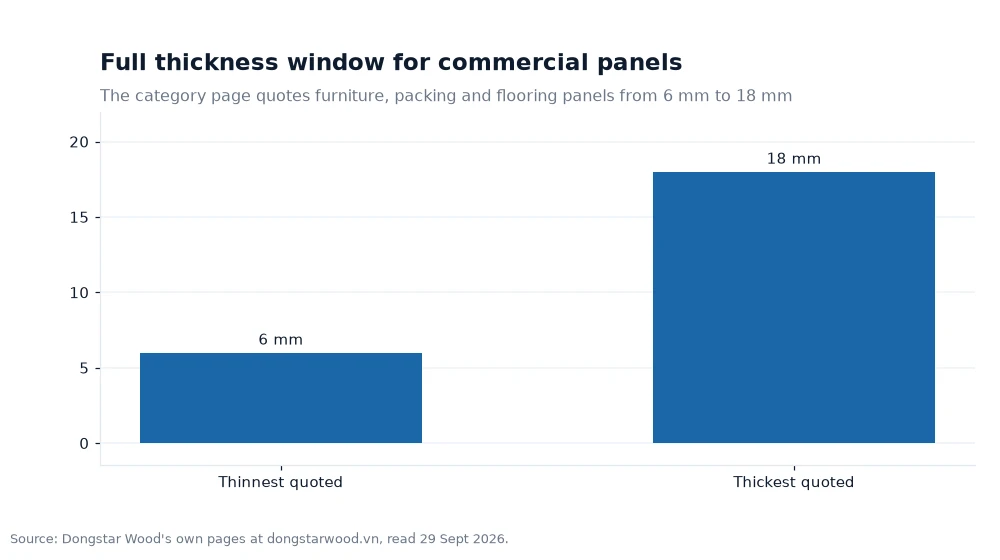
A furniture line that runs the same cabinet carcass for months does not need a spectacular panel; it needs one whose thickness, glue class and face quality repeat. The published commercial range runs from 6 mm to 18 mm, which covers drawer bottoms, cabinet backs, shelves and heavy worktops from a single supply agreement.

Key takeaways
- Match thickness to the job: 6 – 9 mm backs and drawer bottoms, 12 – 15 mm shelving and office units, 18 mm worktops and structural panels.
- Choose the glue class by exposure, not by habit — MR for dry interiors, WBP where humidity is expected.
- Standardise on two thicknesses where you can, because every extra size adds a separate cutting and packing routine.
- For European programmes, put duty exposure on the agenda: the client markets its Vietnam output under No Anti-Dumping Tax for EU and US buyers.
Why thickness discipline beats panel prestige
High-volume production rewards repetition. When a plant presses the same thickness every week, the press settings, sanding passes and packing jigs stay constant, and panels arrive flat and dimensionally equal. Buyers who order a different thickness for each new model end up financing the supplier's setup time instead.
The published commercial panel range spans 6 mm to 18 mm, with furniture, cabinet, packing, flooring and construction uses named on the category page. Picking from a range that wide is easy; picking consistently is what protects the line rate.
A repeat line of Commercial Plywood is where the economics improve: the mill holds one specification steady, which is what keeps thickness and face grade consistent between deliveries.
Thickness choices, application by application
Cabinet backs, drawer bottoms and light partitions work in the thinnest band, 6 – 9 mm. Shelving, office furniture and hotel fixtures sit in the middle, 12 – 15 mm, where stiffness matters but weight still affects handling. Heavy-duty furniture, worktops and structural panels belong at 18 mm, which is why a two-thickness standard of 12 mm and 18 mm turns up so often on contractor orders.
Sizes on offer include 1220 × 2440 mm and 1250 × 2500 mm, plus the larger 1250 × 3000 mm and 1500 × 3000 mm options, with custom formats up to 1830 × 3830 mm. A cutting plan built around one standard size usually wastes less than one that hops between formats.
| Thickness | Typical use | Planning note |
|---|---|---|
| 6 – 9 mm | Cabinet backs, drawer bottoms, partitions | Most economical way to close a carcass |
| 12 – 15 mm | Office furniture, shelves, hotel fixtures | The practical default for mid-size panels |
| 18 mm | Heavy furniture, worktops, structural panels | Common contractor standard in Europe |
| Custom up to 1830 × 3830 mm | Oversized and one-off components | Order with the standard sizes, not instead of them |
Face veneers and finishing lines
The face decides how much your finishing department has to do. The published veneer options are Birch, Pine, Bleached Poplar, EV and Rose Eucalyptus, over Acacia Core, Bodhi Core, Eucalyptus Core or Combi Core. A uniform, light face takes stain or laminate predictably; a variable one forces your sander to work panel by panel.
Ask for grade codes to be written into the order, not agreed verbally. When a face grade slips, the cost lands in your finishing room rather than in the mill's invoice, and a written code is the only argument that works after the container has arrived.
Veneer choice is also a scheduling question. A mill that presses the same face species in long runs can hold colour and grain consistent across containers; a mill switching species every fortnight cannot. If your catalogue shows timber grain, lock the species as well as the grade, and keep one alternative agreed in advance for months when that veneer is short.
Core structure in furniture frames
Core choice drives stiffness and screw-holding more than face choice does. Eucalyptus Core is dense hardwood with high compression resistance, which suits shelving under load. Acacia Core brings density and load-bearing capacity for heavier frames. Combi Core blends Eucalyptus with Acacia, or a hardwood layer with a softwood one, holding stiffness while trimming both weight and cost — a sensible middle path for mixed-cabinet work.
Where the panel is visible only at the edge, the cheaper of two cores that meet the load case is usually the right answer. Conservation of stiffness is a design decision, not a purchase decision.
Worked example: cost of a size change
Take a 1220 × 2440 mm sheet, as an example: 1.22 × 2.44 = 2.98 m². A monthly programme of 18,000 sheets is 18,000 × 2.98 = 53,640 m² of panel. If a model change adds a second size and splits that volume into two runs of 9,000 sheets, panel area stays the same but the cutting plan, packing jig and inspection lot double.
The same logic applies to thickness. Two thicknesses in one order mean two press cycles and two handling routines; four thicknesses mean four. Consolidating a catalogue around 12 mm and 18 mm is normally the most economical engineering decision available to a furniture maker.
Duty exposure and where the panel is pressed
For European buyers, landed cost includes more than freight. The client markets its Vietnamese production with No Anti-Dumping Tax for the EU and US markets, and that position matters when a buyer is comparing a landed price with a supplier that carries duty risk. The category page also names OEM and custom plywood work, alongside furniture plywood, hardwood plywood and veneer plywood production, so a specification can be adjusted rather than accepted as-is.
Confirm the duty position in writing with the quotation. Trade measures move, and a stated position in a document is easier to verify than a claim made in a call.
Quality checks before the first big run
Three checks catch most problems before volume arrives. Measure thickness in the middle and near the edges of several sheets, look for face veneer blisters after conditioning the panel to workshop humidity, and run one full cabinet assembly with the production drill and edgebander. If the panel machines cleanly on the first attempt, it will machine cleanly for the rest of the run.
The mill's own process supports this: raw material inspection through to export batch testing happens in-house, and a pre-shipment report naming thickness consistency and core integrity is a reasonable request on any order.
Then repeat the checks on the first two deliveries and compare the notes. Thickness that drifts by a fraction of a millimetre across four sheets is a press setting; the same drift on eight sheets from two different batches is a process that has changed. Catching that early costs one email, and catching it after assembly costs a pallet of finished cabinets.
Frequently asked questions
Which thickness should a cabinet range standardise on?
Two thicknesses cover most of a catalogue: 12 mm for shelves, fixtures and mid-size panels, and 18 mm for worktops and heavy carcass parts. Thinner panels down to 6 mm remain available for backs and drawer bottoms where load is not a factor.
MR or WBP glue for interior furniture?
MR is the dry-interior choice and covers most living and office furniture. WBP is the safer specification for kitchens, bathrooms and any panel that meets humidity or brief water contact, and it is the one to write down where warranty discussions are likely.
Can a furniture maker mix core species in one order?
Yes, and it is often efficient: a dense core for load-bearing shelves and a lighter hybrid core for visible flat panels. Ask for the core to be stated per line item so that inspection and any later claim stay unambiguous.
Next step for a production buyer
Pull your cutting list together before the first enquiry and send it with the enquiry. The birch panel lines cover the visible-face work where a clean, light veneer matters, while the company profile gives the plant figures and certification list that a purchasing file usually needs in its first pages.
Panel data in this piece is taken from that that the supplier's website, which I read on 29 September 2026 as applied to this guide as applied to this guide and used in this comparison[1].