A Closer Look at Comparing machinery quotations and inclusions
Machinery offers often differ in configuration, engineering, installation, delivery basis, and service. A buyer can make a defensible comparison by normalizing those elements, recording exceptions, and testing assumptions before selecting a supplier.
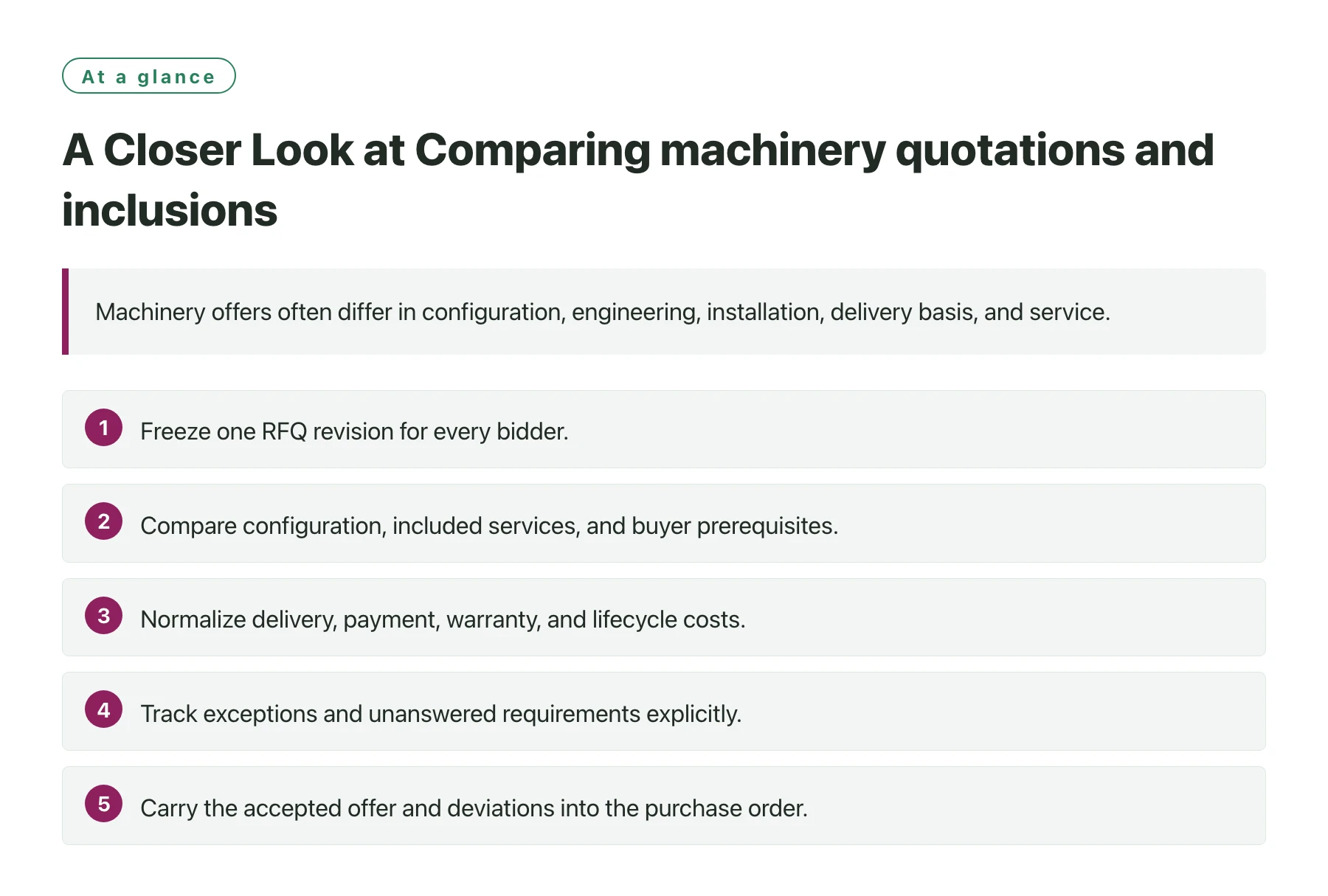
Key takeaways
- Freeze one RFQ revision for every bidder.
- Compare configuration, included services, and buyer prerequisites.
- Normalize delivery, payment, warranty, and lifecycle costs.
- Track exceptions and unanswered requirements explicitly.
- Carry the accepted offer and deviations into the purchase order.
A quotation comparison is a technical and commercial control. The goal is to make material differences visible before they become change orders, missed milestones, or acceptance disputes.
1. Normalize the request before comparing offers
A machinery quotation is only comparable when each supplier prices the same operating requirement, configuration, and delivery basis. Start by freezing a request-for-quotation pack: application, duty cycle, output range, materials, accuracy, utilities, environment, interfaces, safety expectations, and required documents. Identify which values are mandatory and which may be proposed as alternatives.
Send the same revision and response template to every candidate. Ask suppliers to list exceptions beside the relevant requirement instead of burying them in a general note. Record the date, currency, validity period, and contact responsible for clarifications. If the request changes, issue a new revision and request updated prices from all bidders.
2. Compare the machine configuration line by line
Create a configuration matrix covering base model, capacity, motors, controls, tooling, fixtures, guards, sensors, software, accessories, and spare parts. A supplier may quote a base machine while another includes options that materially affect output or usability. Normalize those differences before reading the total price.
For every offered component, record manufacturer, model, quantity, origin if relevant, and whether it is standard or optional. Ask about substitutions and obsolescence. A low price may depend on a different component or reduced scope; that can be acceptable when visible, evaluated, and approved against the user requirement.
3. Separate included work from buyer-side work
List installation, commissioning, operator training, trial runs, manuals, drawings, remote support, travel, and warranty service separately. State duration, location, number of people, and assumptions. “Installation included” may not identify who supplies lifting equipment, local technicians, site preparation, or utilities.
Ask each supplier to identify buyer responsibilities and prerequisites. Include foundations, electrical supply, compressed air, network access, production material, permits, and safe access where applicable. An inclusion with an unstated prerequisite can become an extra cost or schedule issue after the order is placed.
4. Reconcile price structure and commercial assumptions
Compare equipment price, options, engineering, packing, inland transport, export handling, insurance, freight, duties, taxes, and destination services as distinct lines. Note whether prices are one-time, recurring, estimated, or excluded. Ask for unit prices and quantity breaks when spare parts or consumables are included.
Check payment milestones, deposit, progress evidence, retention, currency, bank fees, quotation validity, lead time, and cancellation terms. Model the cash timing as well as the total. A payment schedule tied to a clearly defined deliverable is easier to administer than a milestone whose completion is subjective.
5. Align delivery terms and named locations
Confirm the delivery rule, version, and precisely named place or port. The ICC explains that Incoterms rules allocate specified responsibilities, costs, and risks between seller and buyer; the quoted rule should therefore be stated with its location and version rather than treated as a generic shipping price. [1]
Do not infer that a delivery term covers every customs, unloading, installation, or insurance obligation. Ask the supplier to itemize what its price includes and have a qualified logistics or trade professional review the transaction-specific allocation. Add a separate landed-cost estimate for charges outside the supplier offer.
6. Evaluate technical evidence without confusing it with price
Ask for a compliance matrix that maps each requirement to the offered configuration, evidence, assumptions, and deviation. Request relevant drawings, data sheets, performance curves, test methods, and sample results. Confirm whether a stated capacity is theoretical, demonstrated, or guaranteed under defined operating conditions.
Distinguish document review from independent verification. Certificates or supplier declarations may help explain a claim, but they do not automatically prove that the quoted machine will meet a buyer’s actual duty. Identify who approves technical evidence and whether a factory acceptance test or third-party review is needed before payment or shipment.
7. Compare warranty, service, and lifecycle support
Normalize warranty start date, duration, covered parts and labor, exclusions, response time, and claim procedure. Ask how service is delivered across the buyer’s location and time zone, what remote diagnostics are available, and who pays travel and freight for replacement parts. Confirm which spare parts are stocked and which have long lead times.
Estimate predictable operating costs such as consumables, recommended spares, maintenance, software licenses, training refreshers, and energy demand when the data is available. A purchase price comparison is incomplete if one offer depends on a costly proprietary input or limited service route that another avoids.
8. Track exceptions and uncertainty explicitly
Maintain an exception register with requirement, supplier response, cost effect, performance or schedule effect, evidence requested, decision owner, and closure date. Classify items as accepted, rejected, pending, or requiring a revised offer. Do not convert a blank response into an assumed yes.
Where a supplier cannot confirm a detail, record the assumption used for comparison and its downside if wrong. Request a priced option or written clarification when uncertainty could change the selection. This creates a decision trail that can be transferred into the contract and later checked during design review and acceptance.
9. Build a risk-adjusted comparison
Use weighted criteria such as functional fit, configuration completeness, evidence quality, delivery schedule, serviceability, supplier capability, and total landed cost. Set weights before scoring so a preferred bidder does not receive favorable criteria after the fact. Keep mandatory pass/fail requirements separate from weighted preferences.
Run sensitivity checks on currency, freight, installation, spare-parts needs, and schedule. Identify the few assumptions that could change the ranking. If a risk is material, seek a clarification or commercial commitment rather than disguising it in a precise-looking score.
10. Convert the chosen quotation into a controlled order
Before award, confirm that quotation revision, drawings, options, exceptions, delivery term, payment, test plan, documentation, and warranty language match the negotiated understanding. Attach the accepted configuration and a dated exception list to the purchase order or contract. Name the people authorized to approve changes.
Buyers comparing industrial equipment sourcing support can use a single comparison matrix to align supplier offers, clarify exclusions, and prepare a traceable award decision. Recheck the final supplier acknowledgment against the approved quotation; a purchase order alone does not resolve conflicting supplier terms unless the contract process says how conflicts are handled.
Sources
Frequently asked questions
What is the most common machinery quotation comparison mistake?
Comparing headline prices before confirming that configuration, scope, delivery basis, and exclusions are equivalent.
Should I compare the lowest price with the most complete offer?
First normalize mandatory requirements and scope, then compare total cost and evidence. Keep optional upgrades visible as separate choices.
What should a machinery quotation state about delivery?
It should identify the agreed delivery rule, its version, and the named location, along with any costs or services excluded from that basis.
How do I handle a supplier that leaves requirements blank?
Record the item as unresolved, request a written response, and avoid treating silence as acceptance.